
About Pongal
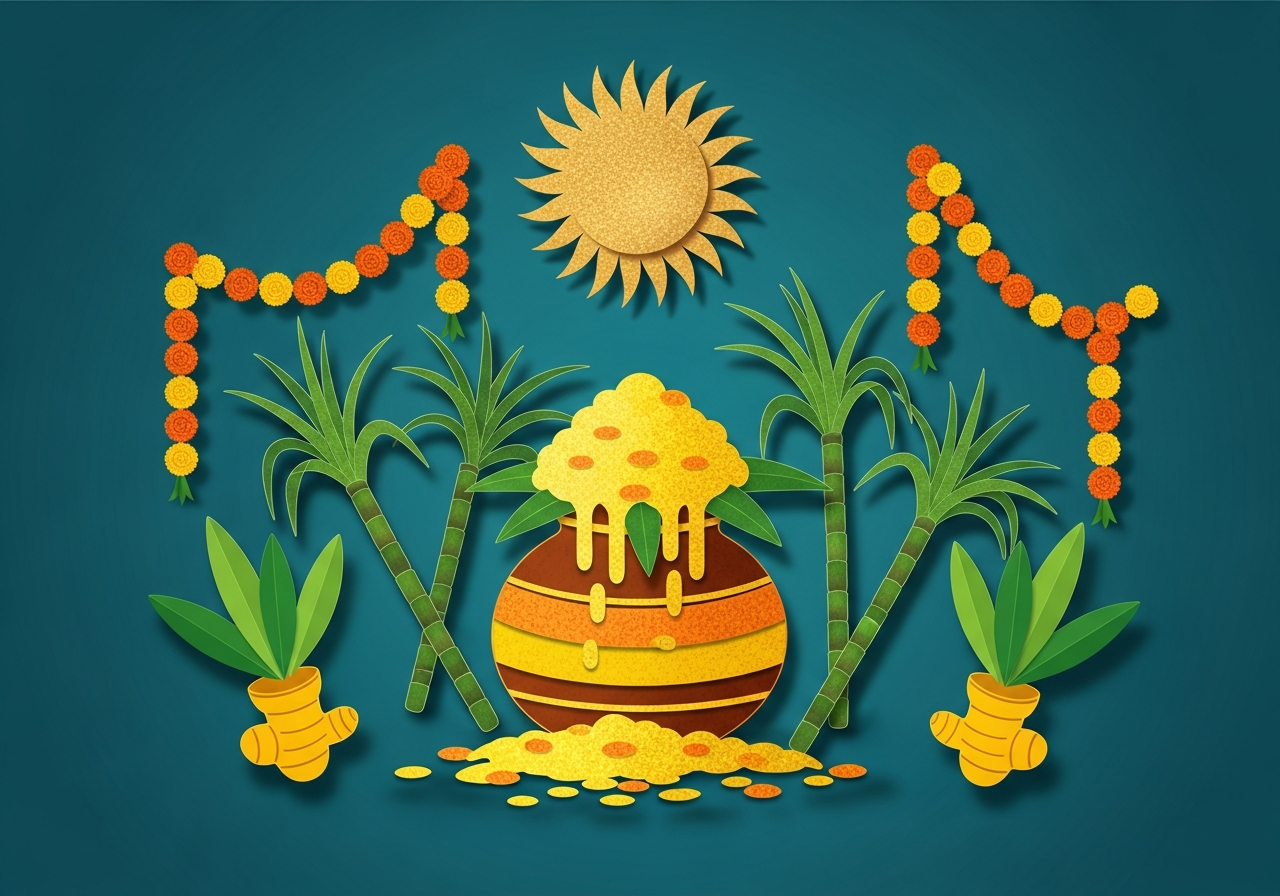
Pongal is the great Tamil thanksgiving — four days timed to the sun's northward turn (Uttarayana) and the close of the rice harvest. The festival takes its name from the dish at its centre: a sweet rice pudding boiled in a clay pot until it overflows, an overflow that is read out loud as a blessing on the household. 'Pongalo Pongal!' the family calls as the milk rises.
For a deeper historical treatment, see Pongal — Wikipedia.
The four days each carry their own focus — Bhogi for clearing out the old, Surya Pongal for thanking the sun, Mattu Pongal for honouring cattle (whose horns are washed and painted), and Kaanum Pongal for visiting family. Doorways are decorated with kolam patterns in rice flour, sugarcane stalks are tied to gates, and turmeric plants are arranged around the cooking pot.
Traditional greetings
The phrases below are the ones most often used to mark Pongal in person, by phone, and on cards. The native-script column shows the greeting as a recipient would read it; the transliteration is for those who would like to say it aloud; the English column is a literal rather than a poetic translation.
| Language | Greeting | Transliteration | English |
|---|---|---|---|
| Tamil | பொங்கல் வாழ்த்துக்கள் | Pongal vazhthukkal | Pongal greetings |
| Tamil | இனிய தைப்பொங்கல் நல்வாழ்த்துக்கள் | Iniya Thai Pongal nalvazhthukkal | Sweet Thai Pongal good wishes |
| Tamil | பொங்கலோ பொங்கல்! | Pongalo Pongal! | May it overflow! |
Design tips for printable Pongal cards
Hand-printed cards for Pongal reward restraint and specific reference. The notes below distil what the most thoughtful cards in the tradition tend to do — and what the most commercial ones tend to get wrong.
- A single brimming clay pot is the most recognisable Pongal motif — render it in warm terracotta, not stylised flat colour.
- Use the kolam pattern around the border in fine white linework on a turmeric-yellow ground.
- Sugarcane silhouettes and the painted horns of cattle are tender, specific Mattu Pongal references that people notice.
- For diaspora cards, include the date in both the Gregorian and Tamil calendar.
- Small flecks of gold leaf on the pot rim mimic the boil-over without literalism.
A starting palette:
Five verses for Pongal cards
Each verse below is short enough to copy onto a folded card by hand. They progress from formal to intimate; pick the one that best fits the relationship and the year you are writing into.
- May your year, like this pot, boil over — with more than you needed, more than you asked for. Iniya Thai Pongal nalvazhthukkal.
- Thanks to the sun for the long warm days, thanks to the rain for the short cool ones, and thanks to you for sharing the harvest with me.
- A new month, a new sun, a new pot — may the sweetness inside spill out over everyone you love. Pongalo Pongal!
- Kolam at the door, sugarcane at the gate, turmeric on the pot — and a wish for you at every threshold. Happy Pongal.
- From our fields to yours, and from our table to yours — a bowl of sweet rice and a year of plenty. Iniya Pongal.
Related cultural holidays
Other holidays observed in the South Asia family of traditions: