
About Raksha Bandhan
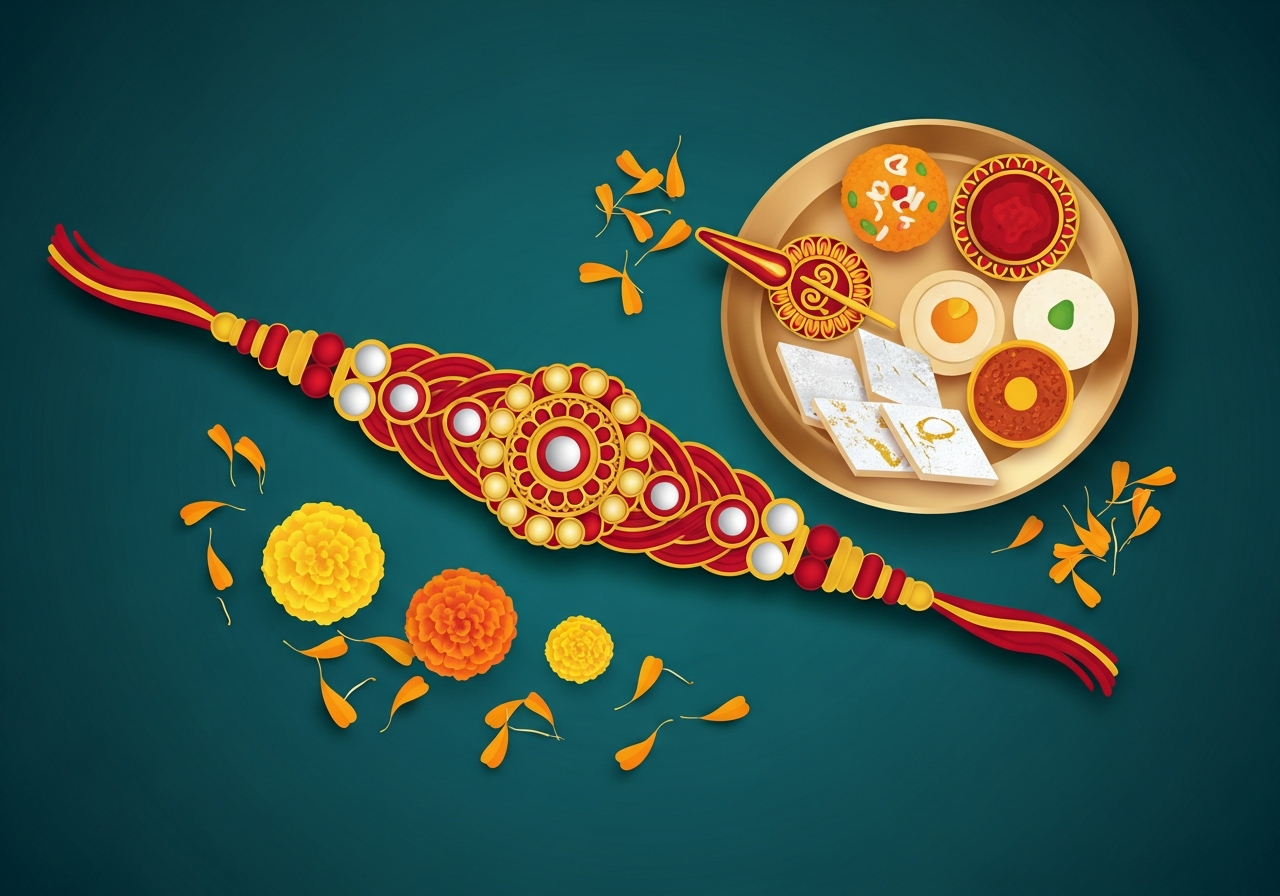
Raksha Bandhan — literally 'the bond of protection' — is observed on the full moon day of the Hindu month of Shravana. A sister ties a decorative thread, the rakhi, around her brother's right wrist, applies a tilak to his forehead, and feeds him sweets. In return the brother offers a gift and a vow of protection. The thread itself is the heart of the rite — silk, cotton, sometimes gold — knotted with the year's wish for the other.
For a deeper historical treatment, see Raksha Bandhan — Wikipedia.
The festival's roots stretch through several histories: Queen Karnavati of Mewar is said to have sent a rakhi to the Mughal emperor Humayun seeking protection; Rabindranath Tagore revived the rakhi as a symbol of Hindu–Muslim unity during the 1905 partition of Bengal. Today it is observed across the diaspora, often by post — sisters mailing rakhis weeks ahead with a folded card so the rite can be completed long-distance.
Traditional greetings
The phrases below are the ones most often used to mark Raksha Bandhan in person, by phone, and on cards. The native-script column shows the greeting as a recipient would read it; the transliteration is for those who would like to say it aloud; the English column is a literal rather than a poetic translation.
| Language | Greeting | Transliteration | English |
|---|---|---|---|
| Hindi | रक्षा बंधन की शुभकामनाएँ | Raksha Bandhan ki shubhkamnayein | Raksha Bandhan wishes |
| Sanskrit | येन बद्धो बली राजा दानवेन्द्रो महाबलः | Yena baddho bali raja | The mantra recited as the rakhi is tied |
| Marathi | रक्षाबंधनाच्या शुभेच्छा | Rakshabandhanachya shubhechha | Raksha Bandhan good wishes |
| Gujarati | રક્ષાબંધનની શુભકામનાઓ | Rakshabandhanni shubhkamanao | Raksha Bandhan blessings |
Design tips for printable Raksha Bandhan cards
Hand-printed cards for Raksha Bandhan reward restraint and specific reference. The notes below distil what the most thoughtful cards in the tradition tend to do — and what the most commercial ones tend to get wrong.
- A single illustrated rakhi — silk thread, mirror bead, marigold — is more affecting than a crowded composition.
- Use deep maroon or aubergine paper with a metallic gold thread inlay; many printers can foil-stamp a single line cheaply.
- Leave a fold-down flap so a real rakhi can be tucked inside the card and posted together.
- For sister-to-sister and chosen-family cards, swap the traditional palette for soft rose and brass.
- Include a small printed mantra in Devanagari at the foot of the verse page for those who want to recite the full rite.
A starting palette:
Five verses for Raksha Bandhan cards
Each verse below is short enough to copy onto a folded card by hand. They progress from formal to intimate; pick the one that best fits the relationship and the year you are writing into.
- This thread is small. What it carries isn't. For every year I've called you mine — happy Raksha Bandhan, brother.
- Distance has never untied us. Neither has time. I'm sending this rakhi the long way home, and all of my love with it.
- May the thread on your wrist be lighter than the love behind it. Happy Rakhi.
- From the first scraped knee to the last shared joke — you have always shown up. This is my way of showing up back.
- Brothers by birth, friends by choice, family by the long, slow proof of years — happy Raksha Bandhan.
Related cultural holidays
Other holidays observed in the South Asia family of traditions: