
About Passover
Passover commemorates the liberation of the Israelites from slavery in Egypt as recounted in the Book of Exodus, when the angel of death 'passed over' the houses of the Israelites whose doorposts were marked with lamb's blood. It begins on the 15th of Nisan with the seder — a long, structured meal, conducted at home rather than in synagogue, that retells the Exodus story through fifteen ritual steps and the reading of the Haggadah. In Israel one seder is held; in the diaspora, two on consecutive nights.
For a deeper historical treatment, see Passover — Wikipedia.
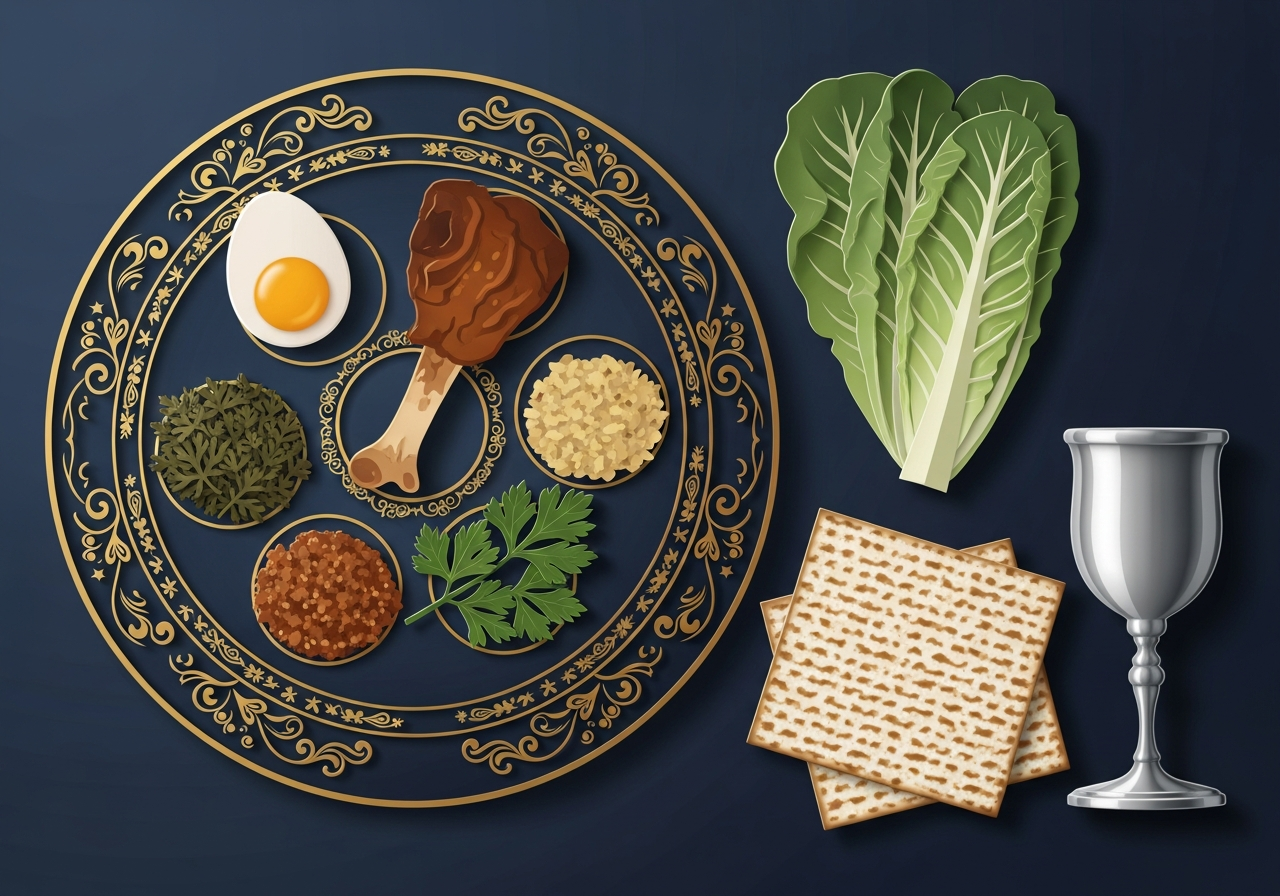
The seder plate holds six symbolic foods — a roasted shank bone, a roasted egg, bitter herbs, charoset (a sweet paste of fruit and nuts), karpas (greens), and chazeret — each with its own moment in the retelling. The youngest at the table asks the Four Questions; four cups of wine are drunk; matzah replaces bread for all eight days. The festival is one of the most home-centred in any tradition, and the cards exchanged before it are warm, often family-only.
Traditional greetings
The phrases below are the ones most often used to mark Passover in person, by phone, and on cards. The native-script column shows the greeting as a recipient would read it; the transliteration is for those who would like to say it aloud; the English column is a literal rather than a poetic translation.
| Language | Greeting | Transliteration | English |
|---|---|---|---|
| Hebrew | חג פסח שמח | Chag Pesach Sameach | Happy Passover holiday |
| Hebrew | פסח כשר ושמח | Pesach Kasher v'Sameach | A kosher and happy Passover |
| Yiddish | אַ כשרן און פֿריילעכן פסח | A kushern un freilichen Pesach | A kosher and joyful Passover |
Design tips for printable Passover cards
Hand-printed cards for Passover reward restraint and specific reference. The notes below distil what the most thoughtful cards in the tradition tend to do — and what the most commercial ones tend to get wrong.
- A seder plate viewed from above, with all six items visible — render them carefully, as families will check.
- A single matzah panel as the cover, with a small embossed line of Hebrew, is elegant and unmistakable.
- Use deep navy and warm gold; avoid Christmas-coded reds and greens.
- For children, a small folded insert with the Four Questions in Hebrew and English is a beloved keepsake.
- Inside, the line 'Ma nishtana ha-laila ha-zeh' — 'why is this night different' — needs no further explanation.
A starting palette:
Five verses for Passover cards
Each verse below is short enough to copy onto a folded card by hand. They progress from formal to intimate; pick the one that best fits the relationship and the year you are writing into.
- May this Passover find your seder full, your wine glass replenished, and the door open for Elijah.
- Chag Pesach Sameach. May the matzah hold, the charoset be sweet, the bitter herbs do their work, and the four questions still surprise you.
- From slavery to freedom, from narrow places to wide ones — may this year carry you the same way.
- Pesach Kasher v'Sameach. May the youngest at the table read the Mah Nishtana well, and may the oldest tell the story as if it had just happened.
- May you taste the bitter and the sweet on the same plate, remember which was which, and still choose, year after year, to set the table.
Related cultural holidays
Other holidays observed in the Jewish Diaspora family of traditions: